Fire-Rated Cables
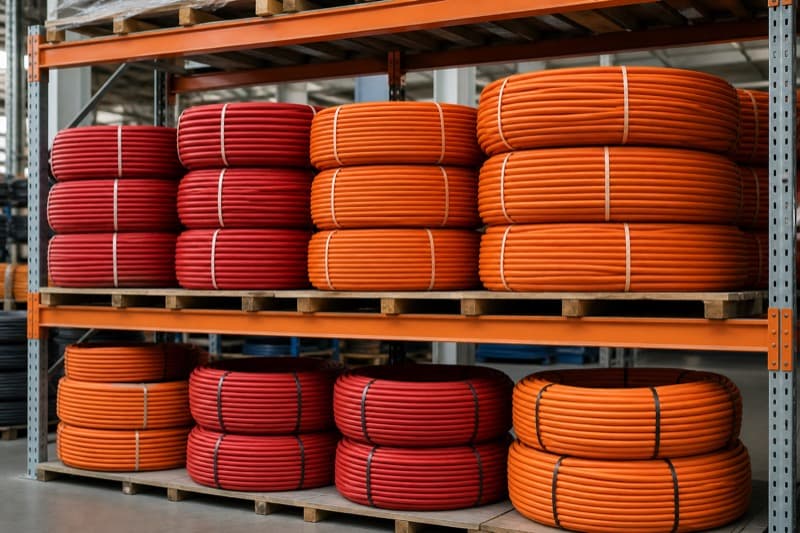
Fire-rated cable keeps circuits alive during a fire, either through fire-resistant (FR) construction that maintains circuit integrity for a set time, or fire-retardant low smoke zero halogen (LSZH) construction that limits flame spread and toxic smoke. NLS sources both classes for life-safety circuits: emergency lighting, fire alarm, smoke extraction fans, and sprinkler pump feeds on hospital and aviation projects.
Fire-rated cable covers two distinct jobs that get confused with each other on a BOQ. Fire-resistant (FR) cable, built with mica glass tape or ceramifiable insulation around the conductor, keeps a circuit electrically alive for a defined period under direct flame, typically rated to BS 6387 or IEC 60331 test categories. Fire-retardant LSZH cable doesn't promise circuit continuity in a fire; it's built to slow flame spread along the cable run and release low smoke and no halogen acid gas if it burns, tested to IEC 60332 and IEC 61034. A project spec that calls out both properties in one cable needs a combined FR/LSZH construction, and it's worth checking the actual clause before ordering the wrong one.
NLS sources both classes, single-core and multi-core, in the conductor sizes and voltage classes hospital and aviation projects specify for life-safety circuits: emergency lighting, fire alarm panels and detector loops, smoke extraction and pressurization fan feeds, sprinkler and jockey pump power, and PA/voice-alarm systems. These are exactly the circuits where a building code or a fire consultant's spec won't accept a standard PVC cable, and where a wrong substitution shows up at commissioning, not before.
Given the standards involved, NLS treats fire-rated cable orders with the same documentation discipline it applies on Aramco-scale cable packages: manufacturer test certificates against the specified standard travel with the delivery, not as an afterthought. A project team sends the fire rating clause from the spec (BS 6387 category, or the LSZH/FR requirement as written), conductor size, and circuit count, and NLS returns a priced quote in USD with lead time based on the specific construction ordered, since fire-rated cable is a lower-volume, made-to-spec product than standard XLPE feeder cable and typically carries a longer lead time.
Specifications
- ✓Fire-resistant (FR): mica/ceramifiable barrier maintains circuit integrity under flame, tested to BS 6387 or IEC 60331
- ✓Fire-retardant LSZH: low smoke, zero halogen sheath, tested to IEC 60332-1/3 and IEC 61034
- ✓Combined FR/LSZH construction available where a spec calls for both properties
- ✓Conductor: copper, single-core and multi-core
- ✓Typical use: fire alarm, emergency lighting, smoke extraction fan, sprinkler pump circuits
- ✓Standards referenced: BS 6387, IEC 60331, IEC 60332, IEC 61034
Frequently Asked Questions
What's the difference between fire-resistant and fire-retardant cable?+
Fire-resistant (FR) cable is built to keep the circuit working during a fire, for a rated time under flame. Fire-retardant cable doesn't guarantee the circuit stays live, it's built to slow flame spread and limit smoke and toxic gas along the cable run. A project spec that needs both properties requires a combined FR/LSZH cable.
What standards apply to fire-rated cable in Saudi Arabia?+
The common reference standards are BS 6387 and IEC 60331 for circuit integrity under fire, and IEC 60332 and IEC 61034 for flame spread and smoke/gas performance on LSZH cable, matched to whatever the project's fire or MEP consultant specifies.
Which circuits typically need fire-rated cable on a Saudi project?+
Fire alarm and detector loops, emergency lighting, smoke extraction and stair-pressurization fans, sprinkler and jockey pump feeds, and public-address/voice-alarm systems are the circuits building codes and fire consultants usually require on FR or FR/LSZH cable.
How long does it take to get fire-rated cable delivered in KSA?+
Lead time runs longer than standard XLPE feeder cable because fire-rated constructions are made to spec rather than held in bulk stock. NLS quotes actual lead time once the fire rating clause, conductor size, and circuit count are confirmed.
Who supplies Fire-Rated Cables in Saudi Arabia?+
NLS Industries (Northlane Solutions Company) supplies Fire-Rated Cables across Saudi Arabia, including Riyadh, Jeddah, Dammam and Jubail. Send your specification and quantities to info@northlanesolution.com for a quotation.