
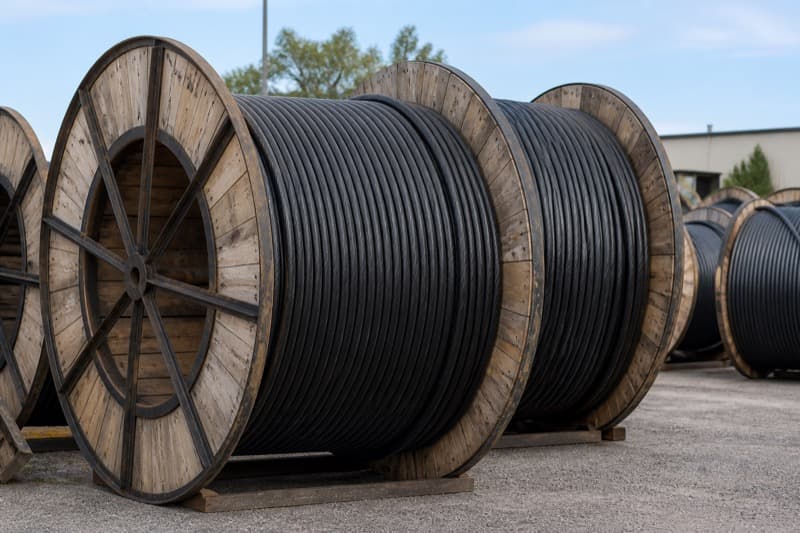
Flexible Rubber Cables
Flexible rubber cable uses an elastomeric insulation and sheath instead of PVC, built for repeated flexing, mobile equipment, and demanding outdoor or workshop use. NLS sources rubber-sheathed flexible cable to IEC 60245, in single and multi-core, for site power tools, mobile plant, and temporary power runs on Saudi construction and industrial sites.
Flexible rubber cable trades the rigidity of PVC or XLPE cable for elastomeric insulation and sheath compounds, usually EPR or neoprene-type materials, that stay flexible and abrasion-resistant even in cold weather or under constant movement. This is the cable that goes on a reel, gets dragged across a site, and coils back up at the end of the shift, something a standard armored feeder cable was never built to do.
NLS sources flexible rubber cable to IEC 60245 across its relevant parts, in fine-stranded copper conductor for maximum flexibility, single-core and multi-core, sized for site power tools, welding sets, mobile compressors, and temporary distribution runs. The rubber sheath handles UV exposure, oil contact, and mechanical abrasion better than standard PVC flex, which matters on a site where the same cable run gets driven over or dragged through debris more than once.
On Saudi construction and industrial sites, flexible rubber cable turns up on temporary power distribution from generator or transformer to site cabins and tool stations, on mobile plant and crane power feeds, and anywhere equipment needs to move without a fixed conduit run. It's a consumable in the sense that it takes physical abuse other cable classes don't, so buyers tend to order it in working lengths rather than long fixed drums.
NLS quotes flexible rubber cable against core count, conductor size, and length required, and returns a priced quote in USD. Because it's a widely manufactured, high-turnover product, standard sizes and common lengths generally source faster than the site's specialty fixed-installation cable classes.
Specifications
- ✓Insulation/sheath: EPR or neoprene-type elastomeric compound
- ✓Conductor: fine-stranded copper for high flexibility
- ✓Standard referenced: IEC 60245 (relevant parts)
- ✓Configuration: single-core and multi-core
- ✓Resistance: UV, oil contact, and mechanical abrasion resistant sheath
- ✓Typical use: site power tools, mobile plant, temporary distribution
Frequently Asked Questions
Why use rubber cable instead of standard PVC flex?+
Rubber sheath compounds hold up better under repeated flexing, cold weather, UV exposure, and oil contact, which matters for cable that gets dragged and coiled across a site rather than installed once and left in place.
What's flexible rubber cable typically used for on Saudi sites?+
Temporary power distribution, site power tools, welding sets, mobile compressors, and crane or mobile plant power feeds, anywhere equipment needs to move without a fixed conduit run.
Does NLS supply flexible rubber cable in custom lengths?+
Yes. Since it's typically ordered in working lengths rather than fixed drums, NLS quotes against the core count, conductor size, and length a project actually needs.
Who supplies Flexible Rubber Cables in Saudi Arabia?+
NLS Industries (Northlane Solutions Company) supplies Flexible Rubber Cables across Saudi Arabia, including Riyadh, Jeddah, Dammam and Jubail. Send your specification and quantities to info@northlanesolution.com for a quotation.