Instrumentation & Gauges
NLS supplies pressure gauges and flow meters for Saudi process, utility and MEP applications, sourcing bourdon-tube and diaphragm gauges across common ranges alongside electromagnetic, ultrasonic and vortex flow meters matched to line size and fluid type. Quotes cover calibration certificates on request, priced in USD, with delivery timed to a project's instrumentation loop check schedule.
What NLS supplies in instrumentation and gauges
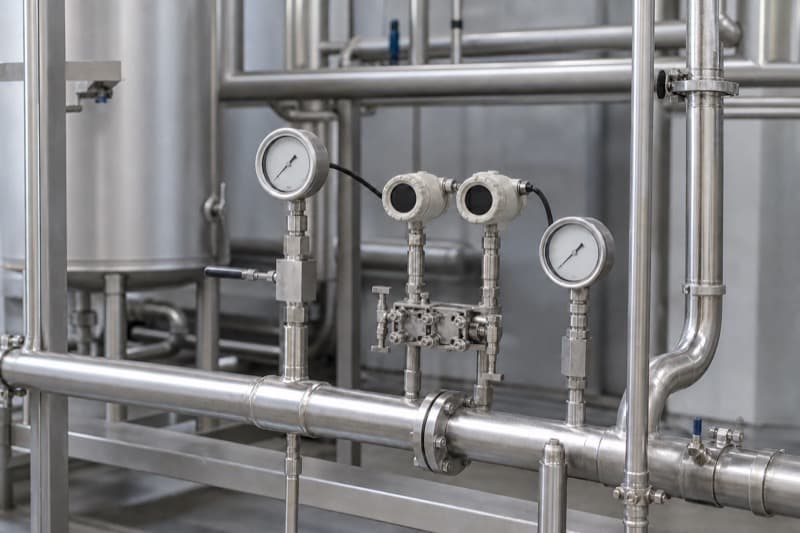
Process and MEP packages on Saudi projects call for two instrument categories on almost every P&ID: pressure gauges for local indication at pumps, compressors and vessels, and flow meters for the loops that feed a control system or a custody transfer point. NLS sources bourdon-tube gauges for general service in ranges from 0-10 bar up to 0-600 bar, and diaphragm-seal gauges for viscous, corrosive or high-temperature service where a direct bourdon tube connection would clog or degrade, in dial sizes from 63mm up to 150mm depending on the panel or local mounting.
Flow meters get matched to the fluid and line size rather than picked generically: electromagnetic meters for conductive liquids like water and wastewater, ultrasonic clamp-on or inline meters where a process can't tolerate a line break for installation, and vortex meters for steam and gas service where other technologies don't hold accuracy. NLS asks for the fluid, line size, pressure class and accuracy requirement before quoting, since a meter sized for the wrong flow range reads badly across most of its operating window.
How sourcing and pricing work
Instrument pricing depends on measurement technology, accuracy class, wetted-part material and any hazardous-area certification the installation requires. NLS quotes in USD against an instrument list or P&ID, with lead time running two to four weeks for standard gauges in common ranges and four to ten weeks for flow meters, longer for larger line sizes or units needing factory wet-calibration before shipment. Calibration certificates traceable to a recognized standard come available on request for gauges and meters where a project's commissioning package requires documented proof.
Why project buyers use NLS for instrumentation
A gauge or meter that arrives without the right range or accuracy class fails a loop check the same day it's installed, so NLS builds the instrument list against the actual P&ID rather than a generic spec sheet, catching a mismatch before the order ships instead of during commissioning. NLS is a Saudi-registered company based in Riyadh, prices instrumentation hardware in USD and handles local delivery and calibration coordination in SAR, and the same desk already quotes a project's cable, valves and motors, so instrumentation closes out against the same RFQ instead of a separate supplier thread.
Related products
Frequently Asked Questions
Who supplies pressure gauges in Saudi Arabia?+
NLS sources bourdon-tube gauges for general service and diaphragm-seal gauges for viscous or corrosive service, in dial sizes from 63mm to 150mm, quoted in USD against a project's instrument list or P&ID.
How does NLS pick the right flow meter for a project?+
NLS asks for the fluid type, line size, pressure class and accuracy requirement before quoting, matching electromagnetic, ultrasonic or vortex technology to the application rather than pricing a generic meter model.
Does NLS provide calibration certificates with gauges and meters?+
Calibration certificates traceable to a recognized standard are available on request, for projects whose commissioning package requires documented proof alongside the gauge or meter itself.
What's the lead time on a flow meter in Saudi Arabia?+
Flow meters typically take four to ten weeks depending on line size and technology, longer for units needing factory wet-calibration before shipment, compared with two to four weeks for standard pressure gauges.
Can NLS quote instrumentation alongside cable and valves for the same project?+
Yes. The same desk that prices a project's cable, valves and motors also quotes its pressure gauges and flow meters, so instrumentation closes out against one RFQ instead of a separate supplier thread.