
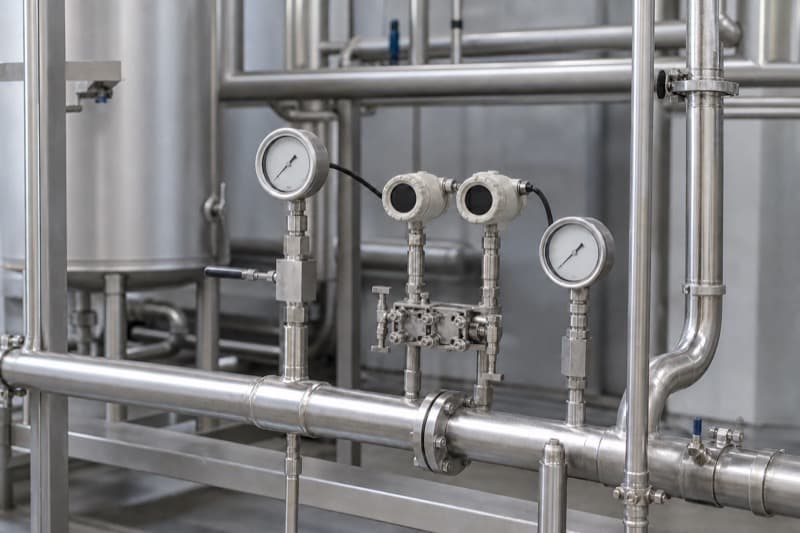
Flow Switches
A flow switch detects the presence, absence, or threshold of liquid or gas flow in a line and trips an electrical contact, protecting equipment like a pump from running dry rather than measuring a flow rate. NLS sources paddle-type and thermal dispersion flow switches with NAMUR-compatible mounting and IP65/IP66 enclosures, for Saudi pump protection and cooling water verification duty.
A flow switch answers a yes-or-no question, is there flow or isn't there, rather than telling you how much is moving through the line. That distinction matters because it's a protection device, not a metering one. The moment flow drops below a set threshold, or stops altogether, the switch changes contact state and can shut a pump down, sound an alarm, or block a downstream process step before a dry-run condition damages equipment.
NLS sources two main technologies. Paddle-type (vane) switches use a mechanical vane inserted into the flow stream that deflects against a spring as flow passes it, tripping a switch when flow falls below the calibrated setpoint, a straightforward, well-proven design for liquids. Thermal dispersion switches instead use two temperature sensors, one heated, one unheated, and detect flow by measuring how quickly the flowing fluid carries heat away from the heated element, with no moving parts to wear or foul. Mounting follows standard NAMUR practice on the proximity and switch styles common to process instrumentation, and enclosures are rated IP65 or IP66 for outdoor, washdown, and dusty industrial duty.
On Saudi projects, flow switches show up on pump dry-run protection (a near-universal requirement on booster and fire pump sets), cooling water loop verification for chillers and compressor packages, HVAC chilled water flow proving before a compressor is allowed to start, and general process interlocks where the absence of flow needs to stop something downstream.
NLS quotes flow switches against the pipe size, fluid type, flow setpoint, process connection, and enclosure rating, and returns a priced quote in USD. Standard paddle-type switches in common pipe sizes typically source fastest; thermal dispersion switches and switches for unusual fluids or hazardous-area classification are more often built to order and carry a manufacturer-confirmed lead time.
Specifications
- ✓Technologies: paddle/vane type (mechanical, general liquids), thermal dispersion (no moving parts)
- ✓Mounting: standard NAMUR mounting practice for proximity and switch-style instruments
- ✓Enclosure protection: IP65, IP66 for outdoor and washdown duty
- ✓Setpoint: field-adjustable flow threshold, calibrated to line size and fluid
- ✓Output: SPDT/DPDT mechanical contact or NAMUR-compatible proximity signal
- ✓Process connection: threaded or flanged, wetted parts in brass or stainless steel
- ✓Typical duty: pump dry-run protection, cooling water and chilled water flow proving
Frequently Asked Questions
What's the difference between a flow switch and a flow meter?+
A flow meter measures and displays the actual flow rate on a continuous basis. A flow switch only detects whether flow is above or below a set threshold and trips a contact accordingly, which makes it a protection device rather than a measuring one.
Why does a pump need dry-run protection?+
A centrifugal pump running without enough liquid overheats quickly since the fluid normally carries heat away from the internals, and the mechanical seal can fail within seconds of running dry, which is why a flow switch interlock is standard on most booster and fire pump specifications.
Does a thermal dispersion flow switch work on gas as well as liquid?+
Yes. Thermal dispersion switches sense flow by heat transfer rate rather than mechanical deflection, which means the same principle works on gas lines as well as liquid ones, unlike a paddle-type switch that depends on a mechanical vane sized for a specific fluid.
Who supplies Flow Switches in Saudi Arabia?+
NLS Industries (Northlane Solutions Company) supplies Flow Switches across Saudi Arabia, including Riyadh, Jeddah, Dammam and Jubail. Send your specification and quantities to info@northlanesolution.com for a quotation.