
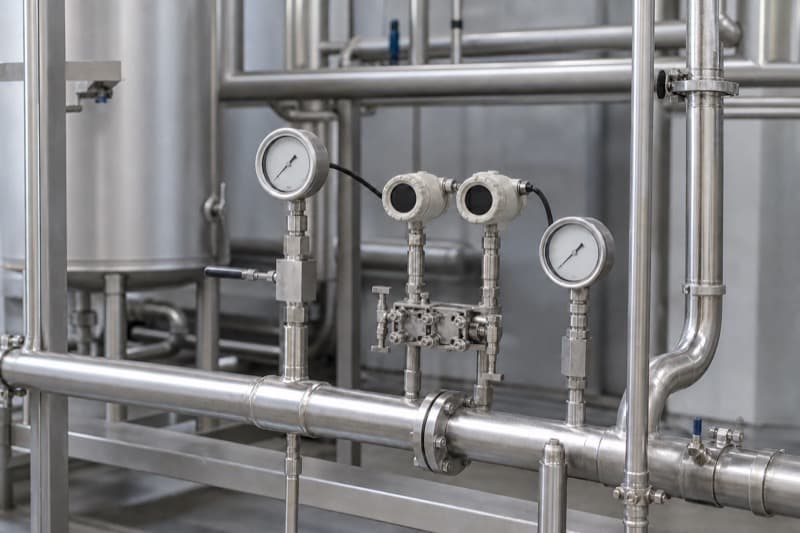
Pressure Gauges
Pressure gauges give a local reading of system pressure using a Bourdon tube, diaphragm, or capsule sensing element, sized to the process fluid and pressure range rather than a generic dial. NLS sources Bourdon tube and diaphragm gauges from 0 to 1,000 bar, stainless steel and brass wetted parts, to EN 837 and ASME B40.100, for Saudi process instrumentation.
A pressure gauge is a mechanical, self-contained instrument, no power supply, no signal wire, just a sensing element that moves a pointer against a dial as pressure changes, which is exactly why it's still the standard local pressure indication on a pump discharge, a compressor line, or a process vessel even on sites that are otherwise fully instrumented with electronic transmitters. Three sensing elements cover most industrial duty. Bourdon tube gauges, the most common type, use a curved tube that straightens slightly under pressure, suited to a wide general pressure range. Diaphragm gauges use a flexible diaphragm instead, better suited to low pressure ranges and viscous or slurry-type media that would clog a Bourdon tube. Capsule gauges, a variant for very low pressure, cover ranges a standard Bourdon tube can't read accurately.
NLS sources gauges across a 0 to 1,000 bar range, in dial sizes typically 63mm, 100mm, and 150mm for readability at different mounting distances, with stainless steel wetted parts and case for corrosive or hazardous-area duty and brass for standard, non-corrosive service. Reference standards are EN 837 for gauge accuracy classes and construction in the European/Gulf market and ASME B40.100 where a project follows US instrumentation practice. Accuracy class (commonly 1.0 or 1.6 under EN 837) matters as much as range, since a gauge selected for too wide a range against the actual operating pressure gives a less precise reading at the point that matters.
On Saudi projects, pressure gauges show up on pump discharge and suction lines, compressor and air receiver instrumentation, boiler and process vessel local indication, and skid-mounted package equipment where the vendor's instrumentation schedule specifies the exact gauge range and connection.
NLS quotes pressure gauges against the required range, dial size, wetted material, and process connection (usually a threaded NPT or BSP fitting), and returns a priced quote in USD. Standard ranges in common dial sizes typically source fastest; unusual ranges or gauges with special features (glycerin-filled for vibration damping, diaphragm seals for viscous media) often carry a longer lead time.
Specifications
- ✓Sensing element: Bourdon tube (general purpose), diaphragm (low pressure/viscous media), capsule (very low pressure)
- ✓Range: 0 to 1,000 bar, project-specific range selected against operating pressure
- ✓Dial size: 63mm, 100mm, 150mm standard
- ✓Standards referenced: EN 837, ASME B40.100
- ✓Wetted material: stainless steel (corrosive/hazardous duty), brass (standard service)
- ✓Options: glycerin-filled (vibration/pulsation damping), diaphragm seal for viscous or crystallizing media
Frequently Asked Questions
What's the difference between a Bourdon tube and a diaphragm pressure gauge?+
A Bourdon tube gauge suits a wide general pressure range and clean media. A diaphragm gauge uses a flexible diaphragm instead, better suited to low pressure ranges and viscous, slurry, or particulate-laden media that would clog or damage a Bourdon tube's narrow internal passage.
How do I choose the right pressure range for a gauge?+
The gauge's full-scale range should sit roughly double the normal operating pressure, so the needle reads in the mid-range during normal operation rather than pinned near the low or high end, which keeps the reading in the gauge's most accurate zone.
What does the accuracy class on a pressure gauge mean?+
It's the maximum error allowed as a percentage of the gauge's full-scale range, commonly 1.0 or 1.6 under EN 837. A tighter accuracy class costs more but matters more where the reading feeds a critical process decision rather than a general go/no-go check.
Why would a pressure gauge need a diaphragm seal?+
A diaphragm seal isolates the gauge's internal mechanism from a viscous, crystallizing, or corrosive process fluid that would otherwise clog or damage a standard gauge, transmitting pressure through a fill fluid instead of direct contact with the process media.
Who supplies Pressure Gauges in Saudi Arabia?+
NLS Industries (Northlane Solutions Company) supplies Pressure Gauges across Saudi Arabia, including Riyadh, Jeddah, Dammam and Jubail. Send your specification and quantities to info@northlanesolution.com for a quotation.