
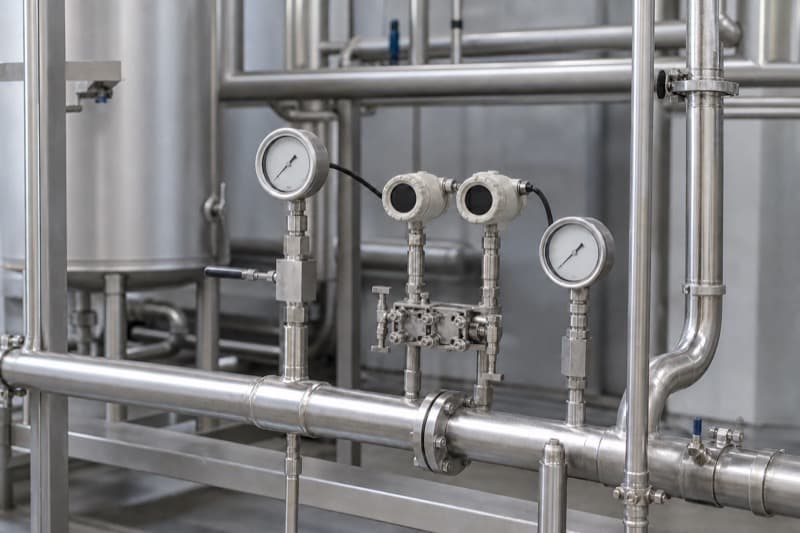
Pressure Transmitters
A pressure transmitter converts process pressure into a continuous 4-20mA or digital signal for a control system, unlike a local gauge that's read by eye. NLS sources pressure transmitters with HART-enabled output and, where required, SIL-rated construction referencing IEC 61508, for Saudi process control, pump and compressor monitoring, and DCS/SCADA-integrated instrumentation.
A pressure transmitter does the same basic job as a pressure gauge, senses process pressure, but where a gauge stops at a needle on a dial, a transmitter converts that pressure into an electronic signal a control system can act on. That's the whole point of the device: it doesn't need a person standing in front of it to be useful, since the signal travels to a DCS, PLC, or SCADA screen instead.
NLS sources pressure transmitters with a piezoresistive or capacitive sensing element housed in a stainless steel or Hastelloy diaphragm assembly, depending on the process fluid's corrosiveness. Standard output is 4-20mA, and most transmitters NLS supplies carry HART digital communication layered onto that same analog loop, referencing the IEC 61158 fieldbus standard family, which lets a technician read diagnostics and re-range the instrument without opening the housing. Where a transmitter forms part of a safety instrumented function, high or low pressure trip on a vessel for instance, IEC 61508 is the general functional-safety reference governing the SIL rating and proof-test interval that loop needs to meet.
On Saudi projects, pressure transmitters show up on pump and compressor discharge monitoring feeding a DCS or SCADA screen, HVAC differential pressure control across filters and coils, process vessel pressure control loops, and skid-mounted package equipment where the vendor's instrumentation schedule calls for a transmitted signal rather than a local-only reading.
NLS quotes pressure transmitters against the required range, accuracy, output protocol (4-20mA, HART, or Profibus), process connection, wetted material, and any hazardous-area certification, and returns a priced quote in USD. Standard transmitters in common ranges typically source faster than SIL-certified or exotic-wetted-material units, which are more often built to order and carry a manufacturer-confirmed lead time.
Specifications
- ✓Sensing element: piezoresistive or capacitive, stainless steel or Hastelloy diaphragm
- ✓Output: 4-20mA analog, HART digital communication (IEC 61158 fieldbus family)
- ✓Functional safety: SIL-rated construction available, referencing IEC 61508
- ✓Process connection: threaded, flanged, or sanitary tri-clamp per application
- ✓Range: gauge, absolute, and differential pressure versions
- ✓Options: local digital display, hazardous-area (Ex) certified housings
Frequently Asked Questions
What does HART mean for a pressure transmitter?+
HART is a digital communication protocol layered onto the standard 4-20mA analog loop, letting a technician read diagnostics, re-range, or reconfigure the transmitter using a handheld communicator or asset management software without disconnecting the loop.
When does a pressure transmitter need to be SIL-rated?+
When it forms part of a safety instrumented function, a high or low pressure trip that shuts down equipment or isolates a vessel before an unsafe condition develops. That loop's required SIL level comes from the project's safety study, and IEC 61508 is the general reference standard governing it.
What's the difference between gauge, absolute, and differential pressure transmitters?+
A gauge transmitter reads pressure relative to atmosphere, the most common type. An absolute transmitter reads relative to a perfect vacuum, used where atmospheric variation would skew the reading. A differential transmitter reads the difference between two pressure points, common on filter monitoring and flow measurement applications.
Who supplies Pressure Transmitters in Saudi Arabia?+
NLS Industries (Northlane Solutions Company) supplies Pressure Transmitters across Saudi Arabia, including Riyadh, Jeddah, Dammam and Jubail. Send your specification and quantities to info@northlanesolution.com for a quotation.