Crane Accessories
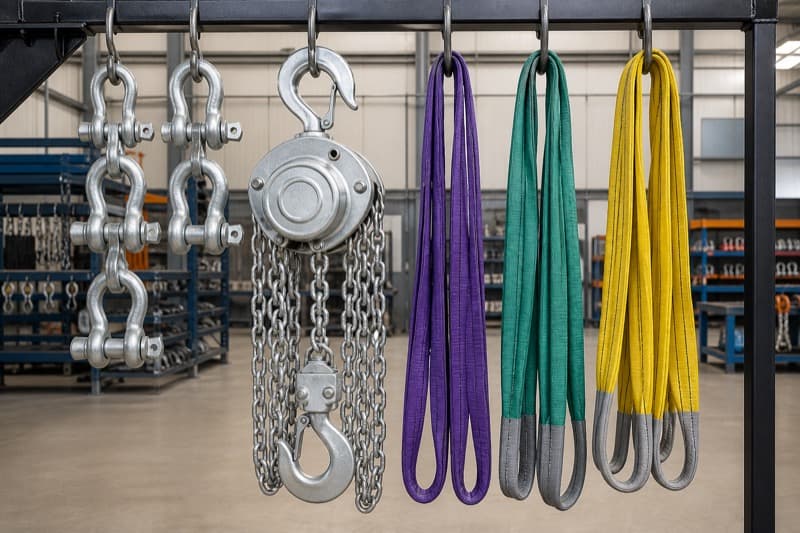
Crane accessories cover the below-the-hook equipment that connects a crane's hook to a load: replacement hooks, spreader and lifting beams for multi-point lifts, and lifting eyes or eye bolts fitted to the load itself. NLS sources these to ASME B30.10 for hooks and ASME B30.20 for below-the-hook devices, matched to a project's specific lift geometry.
Crane accessories, in rigging terms 'below-the-hook lifting devices,' are the equipment that sits between a crane's hook and the load itself: replacement or upgraded hooks, spreader and lifting beams that spread a load across multiple pick points, and lifting eyes or eye bolts fitted permanently or temporarily to the load. None of it moves the load on its own the way a crane does, but a wrong or worn piece here fails the lift regardless of how capable the crane is, which is why this category is engineered and rated as carefully as the crane's own load chart.
NLS sources three main categories. Crane hooks, whether a standard shank hook or a self-locking swivel hook, are rated by capacity and required to carry a safety latch that keeps a sling from slipping off under slack-line conditions, manufactured and inspected to ASME B30.10. Spreader beams and lifting beams turn a single crane hook into two or more pick points spaced to a load's actual lifting points, either as a fixed-geometry beam for a repeat lift or an adjustable beam for varying loads, and they're engineered devices, not generic steel sections, sized to the load and span. Lifting eyes and eye bolts, including swivel and shoulder types, provide a fixed, rated attachment point on the load itself. All three fall under ASME B30.20, the standard covering below-the-hook lifting devices, which sets design, marking, and inspection requirements distinct from the sling or shackle standards.
On Saudi projects, spreader beams and multi-point rigging show up wherever a single load, long structural steel members, precast panels, HVAC skids, has multiple lift points that a single sling angle can't safely reach without overloading one leg. Below-the-hook devices are typically engineered for a specific load and lift plan rather than picked from a general catalog, since a spreader beam sized for the wrong span or capacity defeats the purpose of using one.
NLS quotes crane accessories against the required capacity, lift geometry (number and spacing of pick points), and hook or attachment type, and returns a priced quote in USD. Standard hooks and eye bolts typically source faster than engineered spreader or lifting beams, which are more often built to order against a specific lift plan with a manufacturer-confirmed lead time.
Specifications
- ✓Categories: replacement crane hooks, spreader/lifting beams, and lifting eyes or eye bolts
- ✓Hooks carry a safety latch and are rated/inspected to ASME B30.10
- ✓Spreader and lifting beams engineered per load and span, fixed-geometry or adjustable
- ✓Below-the-hook devices (hooks, beams, eyes) fall under ASME B30.20
- ✓Lifting eye types: swivel and shoulder eye bolts, rated attachment points on the load
- ✓Devices engineered against a specific lift plan, not sold as generic catalog hardware
- ✓Typical use: multi-point lifts on long steel members, precast panels, HVAC skids
Frequently Asked Questions
What's the difference between a spreader beam and a lifting beam?+
A spreader beam carries pick points below the beam and puts the sling legs into compression across the span, which reduces the sling angle load on a wide item. A lifting beam carries pick points along its length with the sling legs in tension, better suited to a narrower or longer load.
Why does a crane hook need a safety latch?+
A safety latch closes the hook's throat opening and keeps a sling or chain from slipping off if the line goes slack momentarily during a lift, a common condition when repositioning a load. ASME B30.10 requires a functioning latch on hooks used in lifting service.
Can a spreader beam be picked from a standard catalog, or does it need to be engineered per lift?+
A spreader or lifting beam has to be sized to the specific load weight, its center of gravity, and the spacing of its actual lift points, not selected off a generic capacity chart. A beam engineered for the wrong span or an assumed center of gravity can overload one pick point even while staying under its total rated capacity.
Who supplies Crane Accessories in Saudi Arabia?+
NLS Industries (Northlane Solutions Company) supplies Crane Accessories across Saudi Arabia, including Riyadh, Jeddah, Dammam and Jubail. Send your specification and quantities to info@northlanesolution.com for a quotation.