
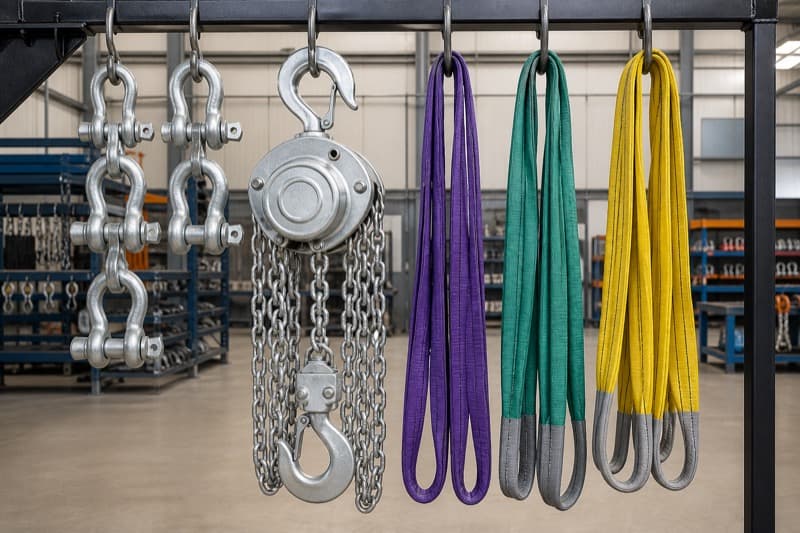
Webbing Slings
A webbing sling is a flat or round synthetic lifting sling woven from polyester or nylon webbing, chosen over wire rope or chain when a load's finished surface needs protection from marking. NLS sources flat and round (endless) webbing slings from 1 to 20 tonnes WLL, manufactured to EN 1492-1 and rated per ASME B30.9, with color-coded capacity labels.
A webbing sling is a lifting sling made from woven synthetic fiber, polyester almost always, formed into either a flat strap with reinforced eyes at each end or a round (endless) sling made from a continuous loop of yarn inside a protective sleeve. It's the lightest and most flexible of the three sling families, and unlike wire rope or chain, it grips a load without biting into a soft or finished surface, which is exactly why it exists as a separate category rather than a cheaper substitute for wire rope.
NLS sources two constructions. Flat webbing slings, woven as a single flat strap with load-bearing eyes, come in one-ply and multi-ply builds depending on the rated capacity, and in eye-and-eye, endless, or reversed-eye configurations depending on how the sling needs to hitch onto the load. Round slings carry the load-bearing yarn as an internal core protected by an outer woven sleeve, which spreads wear more evenly and tolerates a choke or basket hitch better than a flat sling of the same rating. Both constructions are manufactured to EN 1492-1, the European standard for flat webbing slings made of man-made fiber, and rated under ASME B30.9 where a project specifies U.S. practice. Every sling carries a color-coded label stating its working load limit, a synthetic-sling industry convention that lets a rigger check capacity at a glance.
On Saudi sites, webbing slings show up wherever a load's surface can't take a metal sling's contact marks: precast and painted panel lifting, HVAC and mechanical equipment installation, glazing and finished steel handling, and cable drum or crated equipment rigging. Synthetic slings carry a lower temperature and abrasion tolerance than wire rope or chain, so they're specified by surface sensitivity and load weight together, not by convenience alone, and a damaged or cut sling has to be removed from service rather than patched.
NLS quotes webbing slings against the required WLL, sling length, and hitch configuration (eye-and-eye, endless, or choke), and returns a priced quote in USD. Standard capacities in common lengths typically source faster than heavy-tonnage or custom-length slings, which are more often made to order with a manufacturer-confirmed lead time.
Specifications
- ✓Construction: flat webbing (single or multi-ply) and round (endless) slings, woven from polyester
- ✓WLL range: 1 to 20 tonnes
- ✓Hitch configurations: eye-and-eye, endless, and reversed-eye
- ✓Manufactured to EN 1492-1 (flat webbing slings, man-made fiber); rated per ASME B30.9 where specified
- ✓Color-coded WLL labeling per synthetic sling industry convention
- ✓Lower abrasion and temperature tolerance than wire rope or chain slings; damaged slings removed from service, not repaired
- ✓Typical use: precast/painted panel lifting, HVAC and mechanical equipment, glazing and finished steel handling
Frequently Asked Questions
Why choose a webbing sling instead of a wire rope or chain sling?+
A webbing sling protects a load's finished surface from the marking a metal sling can leave, and it's lighter and easier to handle at the same rated capacity. The tradeoff is lower resistance to heat, abrasion, and sharp edges, so it suits surface-sensitive loads rather than rough or high-temperature handling.
What's the difference between a flat webbing sling and a round sling?+
A flat sling is woven as a single strap with reinforced load-bearing eyes, while a round sling carries its load-bearing yarn as a protected internal core inside a woven sleeve, which spreads wear more evenly and handles a choke or basket hitch better at the same capacity.
How is a webbing sling's working load limit indicated?+
Manufacturers attach a color-coded label stating the WLL for straight, choke, and basket hitch configurations, a convention specific to synthetic slings. A sling missing its label, or with a torn or faded one, should be treated as unrated and pulled from service.
Who supplies Webbing Slings in Saudi Arabia?+
NLS Industries (Northlane Solutions Company) supplies Webbing Slings across Saudi Arabia, including Riyadh, Jeddah, Dammam and Jubail. Send your specification and quantities to info@northlanesolution.com for a quotation.