Lifting Slings & Shackles
Lifting slings and shackles connect a load to a crane hook, rated by working load limit (WLL) that must match or exceed the lift weight, not chosen by appearance. NLS sources wire rope, chain, and webbing slings, and bow/dee shackles, from 1 to 50 tonnes WLL, to EN 13414, EN 818, and ASME B30.26, for rigging on Saudi construction sites.
A lifting sling or shackle is rated equipment, not general hardware, and its working load limit (WLL), the maximum load it's certified to lift under specified conditions, is a hard number stamped or tagged on the item, not an estimate. Using an unrated or under-rated piece of rigging is the single most common cause of a dropped load on a construction site, and it's entirely avoidable by matching the rigging to the load with the correct safety factor built in.
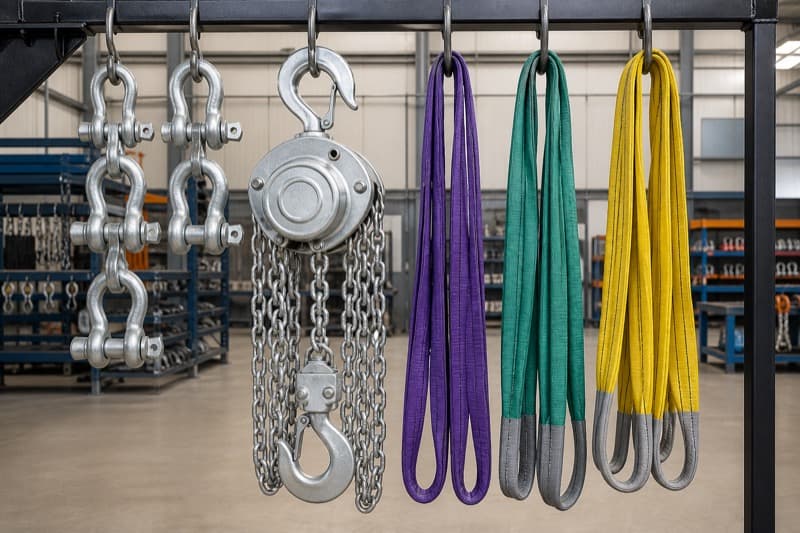
NLS sources three sling types. Wire rope slings handle general heavy lifting with good abrasion resistance, common on structural steel erection. Chain slings suit high-temperature environments and repeated heavy-duty lifting where a wire rope sling would wear faster, common in fabrication yards and plant maintenance. Webbing (synthetic) slings are lighter, more flexible, and protect a load's finished surface better than wire or chain, standard for lighter loads or where the lifted item's surface can't take a metal sling's contact marks. Shackles, bow (rounded) and dee (D-shaped) types, connect the sling to the hook or the load's lifting point, sized by WLL to match the sling rating, not just the pin diameter.
NLS sources this rigging across a 1 to 50 tonne WLL range, to EN 13414 for wire rope slings, EN 818 for chain slings, and ASME B30.26 for rigging hardware including shackles, matched to whatever standard a project's lifting plan specifies. On Saudi projects, rigging shows up on structural steel erection, precast panel and equipment installation, and general plant maintenance lifts, and every lift above a routine threshold typically needs a lift plan that specifies the exact sling type, WLL, and shackle rating for that specific load and geometry, not a generic 'rigging as required' note.
NLS quotes slings and shackles against the required WLL, sling type and length, and shackle size, and returns a priced quote in USD. Common WLL ranges in standard sling lengths typically source faster than heavy-tonnage custom-length slings, which are more often made to order.
Specifications
- ✓Sling types: wire rope (heavy general lifting), chain (high-temp/repeated heavy duty), webbing (light loads, surface protection)
- ✓WLL range: 1 to 50 tonnes
- ✓Shackle types: bow (rounded) and dee (D-shaped), rated to match sling WLL
- ✓Standards referenced: EN 13414 (wire rope slings), EN 818 (chain slings), ASME B30.26 (rigging hardware)
- ✓Marking: WLL stamped/tagged on every sling and shackle, not estimated
- ✓Typical use: structural steel erection, equipment installation, plant maintenance lifts
Frequently Asked Questions
How do I know what working load limit (WLL) I need for a lift?+
The lift plan should specify the WLL based on the actual load weight plus the required safety margin for the lift geometry (sling angle affects the actual load on each leg of a multi-leg sling). Sizing rigging by what looks strong enough instead of the calculated WLL is the most common cause of dropped-load incidents.
What's the difference between wire rope, chain, and webbing slings?+
Wire rope slings suit general heavy lifting with good abrasion resistance. Chain slings handle high temperature and repeated heavy-duty use better than wire rope. Webbing slings are lighter and protect a load's finished surface, standard for lighter loads or delicate surfaces.
What's the difference between a bow shackle and a dee shackle?+
A bow (rounded) shackle has a wider body that accepts multiple sling legs or a wider connection point, while a dee (D-shaped) shackle is more compact and typically rated for straight, in-line pulls. Both are sized by WLL to match the sling rating being connected.
Does every lift on a Saudi construction site need a formal lift plan?+
Most project safety procedures require a lift plan above a defined routine threshold, specifying the exact sling type, WLL, and shackle rating for that specific load and lift geometry, rather than a general note to rig 'as required.'
Who supplies Lifting Slings & Shackles in Saudi Arabia?+
NLS Industries (Northlane Solutions Company) supplies Lifting Slings & Shackles across Saudi Arabia, including Riyadh, Jeddah, Dammam and Jubail. Send your specification and quantities to info@northlanesolution.com for a quotation.