Chain Hoists
A chain hoist lifts and lowers a load along a fixed chain path, using a hand chain, lever, or electric motor, the standard lifting tool wherever a fixed beam or trolley is available. NLS sources hand chain, lever, and electric chain hoists from 0.5 to 20 tonnes, with load chain to EN 818 and hoist design to ASME B30.16.
A chain hoist lifts a load by drawing a load chain through a geared or lever mechanism, anchored to a fixed point overhead, a beam clamp, or a trolley that runs along an I-beam. Unlike a crane, it doesn't move the load horizontally on its own, a hoist only lifts and lowers on a single line, so wherever a job needs vertical lift under a fixed or trolley-mounted point, a chain hoist is usually the simplest and cheapest way to get it done.
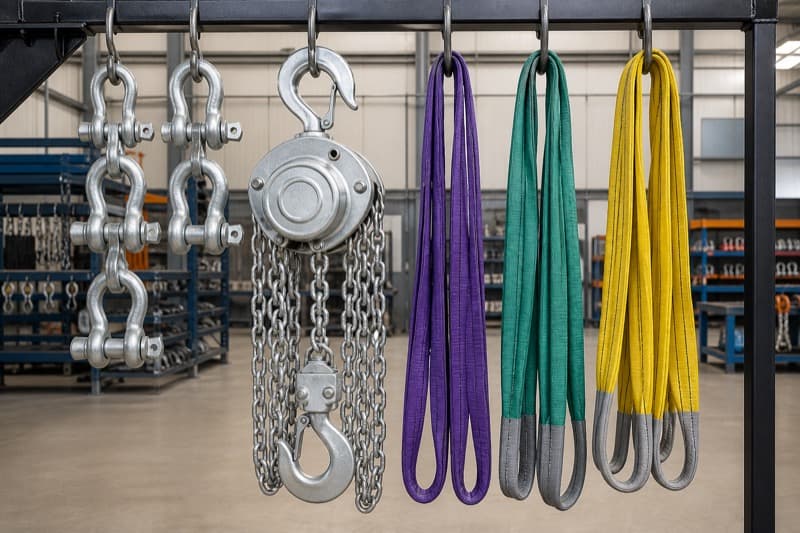
NLS sources three configurations. Hand chain hoists (chain blocks) use a hand-pulled chain looped through an internal gear train, the standard choice for occasional lifts where power isn't available or needed, common in workshops and site maintenance bays. Lever hoists (ratchet hoists) work the same gear principle but through a short ratcheting lever arm instead of a pulled chain, useful in tight spaces or for horizontal pulling as well as vertical lift. Electric chain hoists replace the manual mechanism with a motor, suited to repeated lifting cycles or loads too heavy to move safely by hand. The load chain itself is manufactured to EN 818, the short-link chain standard for lifting applications, and the hoist body, gearing, and load rating follow ASME B30.16, the design and inspection standard for overhead hoists.
On Saudi projects, chain hoists show up wherever a fixed lifting point already exists or can be rigged quickly: mechanical room installation, HVAC unit and pump lifting during plant maintenance, hangar and workshop equipment servicing on aviation sites, and general structural or piping erection where a full mobile crane isn't justified for a small, repeated lift. A hoist's rated capacity has to match the actual load including rigging weight, not just the item being lifted, since the chain and gearing are only certified to the tag capacity.
NLS quotes chain hoists against the required capacity, lift height, and hand chain or electric duty cycle, and returns a priced quote in USD. Standard hand chain hoists in common capacities typically source faster than electric hoists or non-standard lift heights, which are more often built or configured to order and carry a manufacturer-confirmed lead time.
Specifications
- ✓Hoist types: hand chain (chain block), lever (ratchet), and electric, matched to lift frequency and duty cycle
- ✓Capacity range: 0.5 to 20 tonnes
- ✓Load chain manufactured to EN 818 (short link chain for lifting purposes)
- ✓Hoist design, gearing, and load rating follow ASME B30.16 (overhead hoists)
- ✓Mounting options: hook suspension, beam clamp, or push/geared/electric trolley
- ✓Rated capacity applies to total suspended load including rigging weight, not just the lifted item
- ✓Typical use: mechanical room installation, plant maintenance lifts, hangar and workshop equipment servicing
Frequently Asked Questions
What's the difference between a hand chain hoist and a lever hoist?+
A hand chain hoist is operated by pulling a continuous hand chain looped through the gear mechanism, best suited to straight vertical lifts from a fixed overhead point. A lever hoist uses a short ratcheting handle instead, which makes it easier to use in tight spaces and lets it pull loads horizontally as well as lift them.
How is a chain hoist's capacity rated?+
Capacity is rated for the total suspended load, including the weight of any rigging, sling, or lifting beam used with the hoist, not just the item being lifted. The rated capacity is fixed by the hoist's gearing and the load chain's certification to EN 818, and it isn't a figure to estimate around.
When does a project need an electric chain hoist instead of a hand chain hoist?+
An electric chain hoist makes sense for repeated lifting cycles, loads too heavy to move safely by hand, or duty cycles where a manual hoist would slow the work down. A hand chain hoist remains the simpler and lower-cost option for occasional, single lifts at moderate capacity.
Who supplies Chain Hoists in Saudi Arabia?+
NLS Industries (Northlane Solutions Company) supplies Chain Hoists across Saudi Arabia, including Riyadh, Jeddah, Dammam and Jubail. Send your specification and quantities to info@northlanesolution.com for a quotation.