Shackles & Rigging Hardware
A shackle is a U-shaped connector closed by a removable pin, used to join a sling to a hook or a load's lifting point, rated by working load limit like the sling it connects to. NLS sources bow and dee shackles in screw-pin and safety-pin (bolt-type) styles, forged to EN 13889 and rated per ASME B30.26.
A shackle is a forged, U-shaped piece of rigging hardware closed across its open end by a removable pin, the connector that joins a sling, a chain, or a wire rope to a hook, a lifting eye, or another piece of rigging. It's a small component next to the sling or the load it's attached to, but it's also the single point where the whole rigging assembly can fail if it's undersized, worn, or the wrong grade, which is why a shackle is rated and marked with the same seriousness as the sling itself, not treated as generic hardware from a bolt bin.
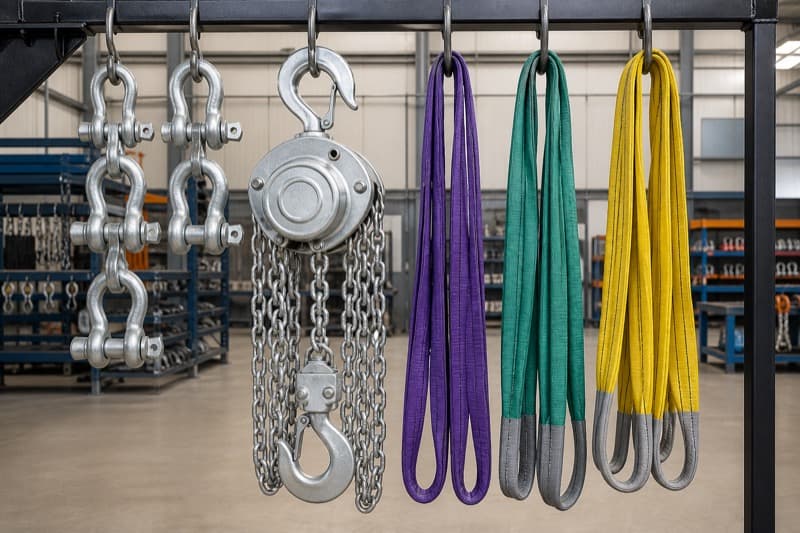
NLS sources two shackle body styles. Bow shackles have a wider, rounded body that accepts multiple sling legs or a bulkier connection at an angle, common where a sling's angle isn't a straight in-line pull. Dee (chain) shackles are more compact with straighter sides, rated for in-line pulls and generally lighter than a bow shackle of the same WLL. Both come in screw-pin styles for general rigging that gets connected and disconnected regularly, and safety-pin (bolt-type) styles with a nut and cotter pin for lifts where the pin can't be allowed to work loose or rotate out. Every shackle NLS sources is drop-forged, not cast, since a cast shackle isn't rated for overhead lifting, and manufactured to EN 13889, the standard for forged steel shackles for general lifting purposes, with ASME B30.26 covering rigging hardware more broadly where a project specifies it. NLS also sources related rigging hardware, forged eye bolts and turnbuckles, to the same grade and certification standard as its shackles, rounding out a rigging schedule beyond the shackle itself.
On Saudi sites, shackles connect nearly every rigging setup: structural steel erection, precast panel lifting, equipment installation, and general crane work wherever a sling needs to terminate at a hook or a fixed lifting point. Shackle size is matched to the sling's WLL, not the pin diameter alone, and mixing shackle grades or replacing a safety-pin shackle with a screw-pin type on a critical lift is a common and preventable rigging error.
NLS quotes shackles and rigging hardware against the required WLL, body style (bow or dee), and pin type, and returns a priced quote in USD. Standard sizes in screw-pin styles typically source faster than heavy-tonnage or safety-pin shackles, which are more often ordered against a specific certification requirement with a manufacturer-confirmed lead time.
Specifications
- ✓WLL range: roughly 0.5 to 50 tonnes across standard bow and dee shackle sizes
- ✓Body styles: bow (rounded, multi-leg or angled connections) and dee/chain (compact, in-line pulls)
- ✓Pin types: screw-pin (general, frequently connected/disconnected) and safety-pin/bolt-type (secured with nut and cotter pin)
- ✓All shackles drop-forged, not cast, for rated overhead lifting service
- ✓Manufactured to EN 13889 (forged steel shackles for general lifting purposes); rigging hardware rated per ASME B30.26
- ✓Shackle size matched to sling WLL, not pin diameter alone
- ✓Also sourced: forged eye bolts and turnbuckles, rated to the same grade and certification standard
Frequently Asked Questions
What's the difference between a bow shackle and a dee shackle?+
A bow (rounded) shackle has a wider body that accepts multiple sling legs or an angled connection, while a dee (chain) shackle is more compact and rated for straight, in-line pulls. Both are sized by WLL to match the sling being connected, not by pin diameter alone.
When is a safety-pin shackle required instead of a screw-pin type?+
A safety-pin (bolt-type) shackle, secured with a nut and cotter pin, is required wherever the pin can't be allowed to loosen or rotate out under vibration or repeated movement, standard on critical or overhead lifts. A screw-pin shackle suits general rigging that's connected and disconnected often.
Why does a forged shackle matter versus a cast one?+
A drop-forged shackle has a denser, more uniform grain structure that gives it a reliable, certified working load limit, while a cast shackle can carry hidden porosity that makes its actual strength unpredictable. Cast shackles aren't rated for overhead lifting under EN 13889 or ASME B30.26.
Who supplies Shackles & Rigging Hardware in Saudi Arabia?+
NLS Industries (Northlane Solutions Company) supplies Shackles & Rigging Hardware across Saudi Arabia, including Riyadh, Jeddah, Dammam and Jubail. Send your specification and quantities to info@northlanesolution.com for a quotation.