
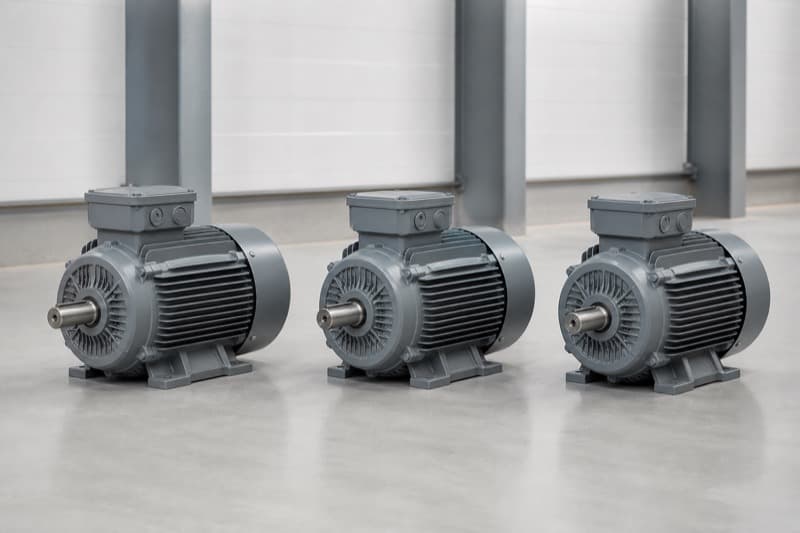
Variable Frequency Drives
Variable frequency drives control AC motor speed and torque by varying the frequency and voltage supplied to the motor, cutting energy use on part-load pumps and fans and giving soft, controlled starts on larger loads. NLS sources VFDs from 0.75kW to 500kW, IP20 panel-mount and IP54 wall-mount enclosures, to IEC 61800, for retrofit and new-build motor control across Saudi process and utility plants.
A variable frequency drive sits between the incoming power supply and the motor, rectifying incoming AC to DC and then inverting it back to AC at a controlled frequency and voltage, which is what lets it change motor speed instead of running it at a fixed line-frequency speed. The main reason plants add one isn't speed control for its own sake, it's energy: a pump or fan running at 80% speed on a VFD can use roughly half the power of one throttled by a valve or damper at full motor speed, because fan and pump load follows a cube law against speed.
NLS sources VFDs from fractional kW units up to 500kW, in IP20 enclosures for panel-mount installation inside a switchroom and IP54 or higher enclosures for wall-mount installation in a plant area without full environmental control, built to IEC 61800 for the drive performance and safety requirements. Selection also depends on whether the load is variable torque (pumps, fans, where a standard VFD works) or constant torque (conveyors, extruders, where a heavier-duty drive and often a larger motor overload margin is needed), on top of the kW rating itself.
Typical Saudi use is retrofit installation on existing pump and fan motors to cut energy cost without replacing the motor, new-build motor control on HVAC and process plant, and soft-start duty on larger motors where a direct-on-line start would create an unacceptable inrush current or mechanical shock on the driven equipment.
NLS quotes VFDs against the motor kW, voltage, load type, and installation environment, and returns a priced quote in USD. Standard IP20 panel-mount drives in common kW ratings typically source faster than IP54 wall-mount units or drives above 200kW, which usually run on a manufacturer-confirmed lead time given lower stock depth at that size.
Specifications
- ✓Power range: 0.75kW to 500kW
- ✓Enclosure: IP20 panel-mount, IP54+ wall-mount for non-controlled environments
- ✓Standards referenced: IEC 61800 series
- ✓Load type: variable torque (pump/fan) and constant torque (conveyor/extruder) selection
- ✓Control: V/f, sensorless vector, or closed-loop vector control modes
- ✓Typical use: energy-saving retrofit, soft start, process speed control
Frequently Asked Questions
Why install a VFD on a pump or fan that already runs fine?+
Energy savings. A pump or fan slowed by a VFD to match actual demand uses roughly half the power of one run at full speed and throttled by a valve or damper, because fan and pump power follows a cube law against speed, not a straight-line relationship.
What's the difference between variable torque and constant torque VFD selection?+
Pumps and fans are variable torque loads and work with a standard VFD sized to the motor kW. Conveyors, extruders, and other constant torque loads need a heavier-duty drive with a larger overload margin, since torque demand doesn't drop off at lower speed the way it does for a pump or fan.
Can a VFD be retrofitted onto an existing motor?+
Yes, in most cases, provided the motor's insulation class and bearing type suit VFD operation, which is standard on most modern industrial motors. NLS quotes the drive against the existing motor's kW and voltage rather than requiring a motor replacement.
What enclosure rating does NLS supply for VFDs?+
IP20 for panel-mount installation inside a switchroom, and IP54 or higher for wall-mount installation in a plant area without full environmental control, matched to where the drive will actually sit.
Who supplies Variable Frequency Drives in Saudi Arabia?+
NLS Industries (Northlane Solutions Company) supplies Variable Frequency Drives across Saudi Arabia, including Riyadh, Jeddah, Dammam and Jubail. Send your specification and quantities to info@northlanesolution.com for a quotation.