
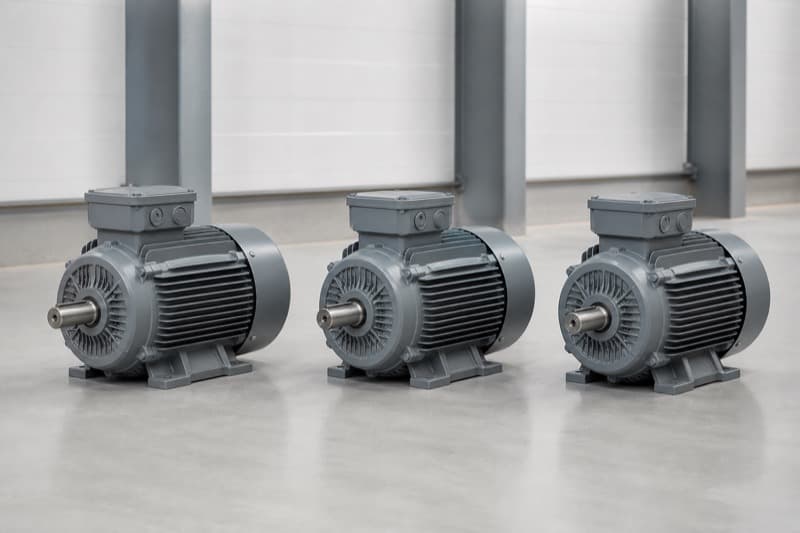
Explosion-Proof Motors
Explosion-proof motors are built to contain an internal spark or arc so it can't ignite a surrounding flammable atmosphere, required wherever a motor runs inside a classified hazardous area. NLS sources Ex d flameproof induction motors certified to IEC 60079-0 and IEC 60079-1, matched to the zone, gas group, and temperature class a project's area classification drawing specifies.
An explosion-proof motor doesn't stop a spark from happening inside the enclosure, it contains it. The flameproof (Ex d) design uses a heavy cast enclosure with precisely machined flame paths at every joint, so if the winding or a bearing arcs internally, hot gas cools and loses enough energy passing through those flame paths that it can't ignite the flammable atmosphere outside the motor. That's a different protection concept from an increased-safety (Ex e) motor, which prevents arcing from happening in the first place rather than containing it after the fact.
NLS sources Ex d flameproof induction motors certified to IEC 60079-0 (general requirements for equipment in explosive atmospheres) and IEC 60079-1 (flameproof enclosures "d"), under ATEX or IECEx zone classification schemes depending on which certification framework the project specifies. General motor performance still follows IEC 60034-1 for rated output and temperature rise, but the certification adds a gas group (IIA, IIB, or IIC) and a temperature class (T1 through T6) that has to match the area classification drawing exactly, not approximately.
Saudi hazardous-area applications for explosion-proof motors sit mainly in oil and gas processing, fuel storage and handling, and any process area with a flammable gas or vapor classification, pump and fan drives inside Zone 1 or Zone 2 areas being the most common call-out. Getting the gas group and temperature class wrong isn't a minor spec miss, it's the difference between a motor that's legally installable in that zone and one that isn't, so the area classification drawing has to be in hand before a motor gets quoted.
NLS quotes explosion-proof motors against the area classification drawing or hazardous-area datasheet, confirming zone, gas group, temperature class, kW, and frame size before pricing, and returns a quote in USD. Ex d motors are near-always built to order rather than stocked off a generic catalog, so lead time runs longer than a standard TEFC motor and is confirmed by the manufacturer once the certification and frame details are locked.
Specifications
- ✓Protection concept: Ex d flameproof enclosure (contains internal ignition, doesn't prevent it)
- ✓Certification: IEC 60079-0 (general requirements) and IEC 60079-1 (flameproof enclosures)
- ✓Zone classification: ATEX or IECEx schemes, matched to project area classification
- ✓Gas group: IIA, IIB, or IIC
- ✓Temperature class: T1 through T6
- ✓General motor performance to IEC 60034-1
Frequently Asked Questions
What's the difference between Ex d and Ex e motors?+
Ex d (flameproof) motors contain an internal spark inside a heavy machined enclosure so it can't reach the outside atmosphere. Ex e (increased safety) motors are built to prevent arcing from happening at all. NLS sources Ex d as the primary hazardous-area motor type.
What information does NLS need to quote an explosion-proof motor?+
The area classification drawing or hazardous-area datasheet: zone, gas group, temperature class, kW, and frame size. Without the zone and gas group confirmed, a quote risks pricing a motor that isn't actually certified for that installation.
How long does an explosion-proof motor take to source?+
Longer than a standard motor. Ex d units are near-always built to order rather than held as generic stock, so lead time depends on the manufacturer once zone, gas group, and frame details are confirmed.
Who supplies Explosion-Proof Motors in Saudi Arabia?+
NLS Industries (Northlane Solutions Company) supplies Explosion-Proof Motors across Saudi Arabia, including Riyadh, Jeddah, Dammam and Jubail. Send your specification and quantities to info@northlanesolution.com for a quotation.