
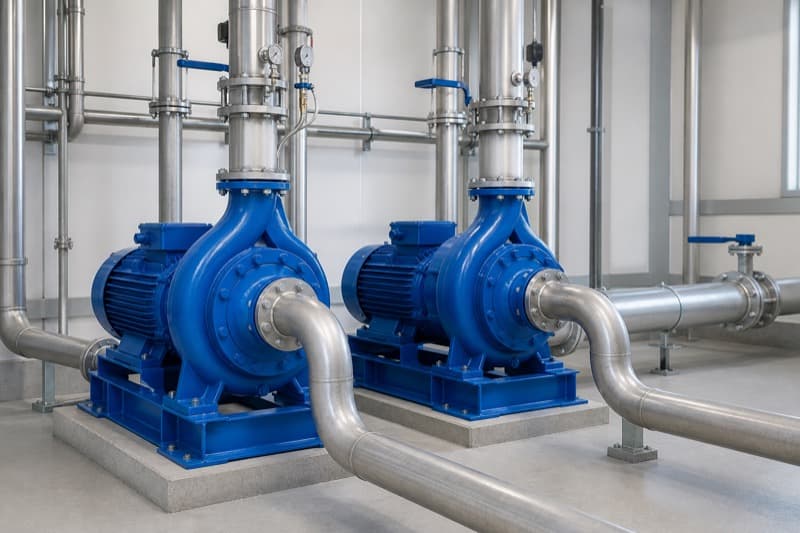
Screw Pumps
Screw pumps use one or more intermeshing rotors to move fluid along a rotor axis at constant, pulsation-free flow, the standard positive-displacement choice for viscous fluids like fuel oil, lubricating oil, and bitumen. NLS sources single and twin-screw pumps built to API 676 rotary positive-displacement pump practice, sized against the fluid's viscosity and the project's flow and pressure duty.
A screw pump moves fluid by trapping it in the sealed cavities formed between one or more helical rotors turning inside a close-fitting housing, then carrying it along the rotor's axis from suction to discharge. Because the fluid moves in trapped pockets rather than being flung outward by centrifugal force, output stays essentially constant regardless of the discharge pressure the pump is working against, and flow comes out smooth and pulsation-free, unlike a piston or gear pump's pulsed delivery.
That behavior is exactly what viscous-fluid service needs. A centrifugal pump loses efficiency fast as fluid viscosity rises, since a thick fluid resists being flung by an impeller the way water doesn't; a screw pump's positive-displacement action barely notices the difference, which is why it's the standard choice for fuel oil transfer, lubricating oil circulation, bitumen and asphalt handling, and other high-viscosity industrial fluids. NLS sources both single-screw (progressive cavity) designs, which handle viscous and often solids-bearing fluids like sludge, and twin-screw designs, which run non-contacting intermeshing rotors for cleaner service like fuel and lube oil where the fluid itself provides no lubrication for rubbing metal parts.
Reference practice is API 676, the rotary positive-displacement pump standard covering screw, gear, and similar pump types used in petroleum, heavy oil, and general industrial process service. On Saudi sites, screw pumps turn up on fuel oil forwarding and transfer systems, lube oil circulation skids for large rotating equipment, and bulk handling of viscous or high-flash-point industrial fluids where a centrifugal pump's performance curve simply doesn't fit the fluid.
NLS quotes screw pumps against the fluid's viscosity at operating temperature, the required flow rate and discharge pressure, and whether the fluid carries any entrained solids, since that last point decides between a single-screw progressive-cavity design and a cleaner twin-screw unit. Viscosity data matters more here than on almost any other pump type NLS quotes: a screw pump sized off a generic flow figure without the actual viscosity curve risks a mismatch the moment ambient or process temperature shifts the fluid's thickness.
Specifications
- ✓Configuration: single-screw (progressive cavity) and twin-screw intermeshing rotor designs
- ✓Standard referenced: API 676 rotary positive-displacement pump practice
- ✓Flow characteristic: constant, pulsation-free output largely independent of discharge pressure
- ✓Fluid range: high-viscosity fluids including fuel oil, lubricating oil, and bitumen
- ✓Sizing basis: fluid viscosity at operating temperature, required flow rate and discharge pressure, entrained solids
- ✓Typical use: fuel oil transfer, lube oil circulation, bulk viscous-fluid and bitumen handling
Frequently Asked Questions
Why does a screw pump suit viscous fluids better than a centrifugal pump?+
A screw pump traps fluid in sealed cavities and carries it along the rotor axis, so it barely loses efficiency as viscosity rises. A centrifugal pump relies on flinging fluid outward, which a thick fluid resists, so its output and efficiency drop fast on oil, bitumen, or similar high-viscosity duty.
What's the difference between single-screw and twin-screw pumps?+
Single-screw (progressive cavity) pumps handle viscous fluids that also carry solids, like sludge, since the rotor design tolerates some particulate content. Twin-screw pumps run non-contacting intermeshing rotors suited to cleaner, non-lubricating fluids like fuel and lube oil where metal-to-metal wear needs to stay off the table.
What data does NLS need to quote a screw pump correctly?+
The fluid's viscosity at actual operating temperature, not a room-temperature figure, plus the required flow rate, discharge pressure, and whether the fluid carries entrained solids. Viscosity shifts with temperature more than most buyers expect, and sizing off the wrong figure is the most common screw pump quoting error.
Who supplies Screw Pumps in Saudi Arabia?+
NLS Industries (Northlane Solutions Company) supplies Screw Pumps across Saudi Arabia, including Riyadh, Jeddah, Dammam and Jubail. Send your specification and quantities to info@northlanesolution.com for a quotation.