Centrifugal Pumps
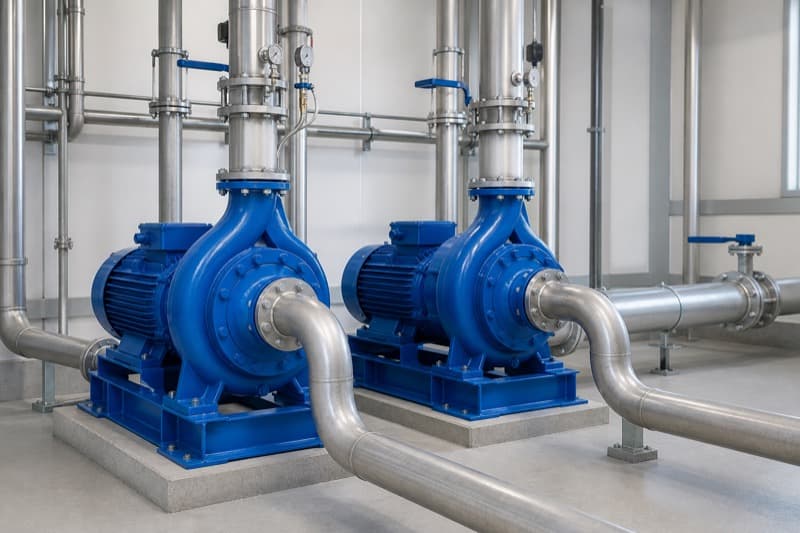
Centrifugal pumps move liquid using a rotating impeller that converts rotational energy into flow and pressure, the standard pump type for water, process, and utility duty. NLS sources end-suction, split-case, and multistage centrifugal pumps from 5 to 500 m³/h, to API 610, ISO 2858, and ANSI B73.1, matched to the head, flow, and NPSH requirements of a project's pump datasheet.
A centrifugal pump moves liquid by spinning an impeller inside a volute casing, which throws the liquid outward and converts that rotational velocity into pressure as it exits. It's the default pump choice for continuous flow duty because it has few moving parts, handles a wide flow range on one casing size, and its output naturally follows a predictable head-flow curve, which makes sizing and system design straightforward once the duty point is known.
NLS sources three main configurations. End-suction pumps, the most common general-service type, cover low to medium flow and head on water, utility, and light process duty. Horizontal split-case pumps handle higher flow rates at moderate head, common on firewater and large utility water systems, and their split casing makes maintenance easier since the rotating assembly lifts out without disturbing the piping. Multistage pumps stack several impellers in series inside one casing to reach higher head than a single-stage pump could deliver, used on boiler feed, high-rise water supply, and higher-pressure process duty. Reference standards are API 610 for pumps in petroleum, petrochemical, and gas industry service, ISO 2858 for general-purpose end-suction pumps, and ANSI B73.1 where a project follows North American practice.
On Saudi projects, centrifugal pumps show up on firewater systems, HVAC chilled and condenser water circulation, process transfer duty, and utility water booster and distribution systems on hospital, aviation, and industrial builds. Correct sizing depends on the full duty point, flow rate, total head, and net positive suction head available (NPSHa), not just a nameplate flow figure, since an undersized NPSH margin causes cavitation regardless of how well the flow and head otherwise match.
NLS quotes centrifugal pumps against the project's pump datasheet or a completed duty-point specification (flow, head, liquid properties, NPSHa) and returns a priced quote in USD. Standard end-suction pumps in common sizes typically source faster than API 610 process pumps or multistage units, which are more often built to order and carry a manufacturer-confirmed lead time.
Specifications
- ✓Configuration: end-suction, horizontal split-case, and multistage
- ✓Flow range: 5 to 500 m³/h (project-specific sizing beyond this range on request)
- ✓Standards referenced: API 610, ISO 2858, ANSI B73.1
- ✓Material options: cast iron, ductile iron, and stainless steel wetted parts
- ✓Sizing basis: flow rate, total head, and net positive suction head available (NPSHa)
- ✓Typical use: firewater, HVAC circulation, process transfer, utility water booster duty
Frequently Asked Questions
What's the difference between end-suction and split-case centrifugal pumps?+
End-suction pumps suit low to medium flow at lower cost and are the standard choice for general water and light process duty. Split-case pumps handle higher flow rates and are easier to maintain since the casing splits to lift out the rotating assembly without disturbing the piping, common on firewater and large utility systems.
What information does NLS need to quote a centrifugal pump?+
The duty point: flow rate, total head, the liquid being pumped, and net positive suction head available (NPSHa), ideally from a completed pump datasheet. Sizing off just a flow figure without head and NPSH risks quoting the wrong pump.
When does a project need an API 610 pump instead of a general-purpose pump?+
API 610 applies to pumps in petroleum, petrochemical, and gas industry service, with heavier-duty construction and stricter mechanical seal and bearing requirements than a general ISO 2858 water pump. A project's process engineer specifies API 610 where the service demands it.
What happens if a centrifugal pump is undersized on NPSH?+
The pump cavitates, forming and collapsing vapor bubbles at the impeller eye, which damages the impeller over time and drops pump performance below the design curve, regardless of whether the flow and head otherwise match the duty point.
Who supplies Centrifugal Pumps in Saudi Arabia?+
NLS Industries (Northlane Solutions Company) supplies Centrifugal Pumps across Saudi Arabia, including Riyadh, Jeddah, Dammam and Jubail. Send your specification and quantities to info@northlanesolution.com for a quotation.