Slurry Pumps
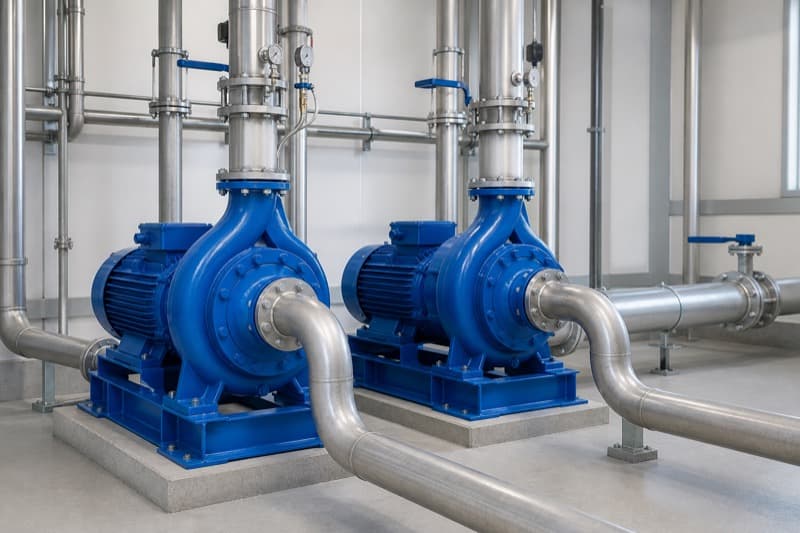
Slurry pumps move liquid carrying suspended solids, sand, tailings, or process sludge, built with thicker, abrasion-resistant wetted parts than a standard water pump would survive. NLS sources horizontal centrifugal slurry pumps to ISO 5199 construction reference, with rubber or hard-metal ASTM A532 liners, for mining, dewatering, and industrial process duty across Saudi sites.
A slurry pump does the same basic job as a centrifugal pump, spinning an impeller to move liquid, but everything about its construction assumes the liquid is carrying solids that would chew through a standard pump's casing and impeller within weeks. Wall thickness runs heavier throughout, the impeller and casing get lined with either natural rubber for fine, less abrasive slurry or hard metal alloy for coarse, sharp-edged material, and the whole flow path is shaped to keep velocity high enough that solids don't settle and clog the pump mid-run.
NLS sources horizontal centrifugal slurry pumps built around ISO 5199, the general construction reference standard used across chemical and heavy-duty pump service, applied here to the heavier casing and shaft design a slurry duty needs rather than a light-duty water pump frame. Liner material follows ASTM A532, the abrasion-resistant white iron alloy specification most hard-metal slurry liners are cast to, selected against the solids' particle size, hardness, and concentration in the slurry stream.
On Saudi sites, slurry pumps show up on mining and quarry operations moving tailings and wash water, construction dewatering where the water being pumped out carries sand and silt rather than running clean, and industrial process lines handling sludge or particulate-laden waste streams. The selection call between a rubber-lined and hard-metal-lined pump comes down to particle sharpness and size: rubber handles fine, rounded particles and resists corrosion well, while hard metal survives coarse, angular material that would cut through rubber lining fast.
NLS quotes slurry pumps against the slurry's solids content by percentage, particle size range, and the specific gravity of the mixture, not just a flow and head figure, since a slurry pump sized off clean-water hydraulics alone will underperform once real solids loading hits it. Lead time runs longer than a standard centrifugal pump because liner material and impeller design are typically built to the specific slurry duty rather than pulled off a generic stock configuration; NLS confirms the realistic figure once the solids data comes in.
Specifications
- ✓Configuration: horizontal centrifugal slurry pump, rubber-lined or hard-metal-lined
- ✓Construction reference: ISO 5199 heavy-duty pump construction
- ✓Liner material: ASTM A532 abrasion-resistant white iron alloy for hard-metal linings
- ✓Liner selection: natural rubber for fine/rounded particles, hard metal for coarse/angular particles
- ✓Sizing basis: flow rate, head, solids concentration by percentage, particle size, and slurry specific gravity
- ✓Typical use: mining and quarry tailings, construction dewatering with sand/silt loading, industrial sludge transfer
Frequently Asked Questions
How is a slurry pump different from a standard centrifugal pump?+
A slurry pump carries heavier wall thickness and a rubber or hard-metal liner on the casing and impeller, built to survive suspended solids that would wear through a standard water pump's parts in weeks. The impeller design also keeps flow velocity high enough to stop solids settling out mid-pump.
Should a slurry pump be rubber-lined or hard-metal-lined?+
Rubber lining suits fine, rounded particles and gives good corrosion resistance for less abrasive slurry. Hard-metal lining, cast to ASTM A532, survives coarse, angular material like mining tailings that would cut through a rubber liner quickly. The choice depends on particle size and sharpness.
What data does NLS need to size a slurry pump correctly?+
Solids concentration by percentage, particle size range, and the mixture's specific gravity, alongside the usual flow and head figures. Sizing off clean-water hydraulics alone understates what the pump needs to handle once real solids loading hits it.
Who supplies Slurry Pumps in Saudi Arabia?+
NLS Industries (Northlane Solutions Company) supplies Slurry Pumps across Saudi Arabia, including Riyadh, Jeddah, Dammam and Jubail. Send your specification and quantities to info@northlanesolution.com for a quotation.