Multistage Pumps
Multistage pumps stack several impellers in series inside one casing to build pressure well beyond what a single-stage pump can reach, the standard choice for reverse osmosis feed, boiler feedwater, and high-rise water supply. NLS sources horizontal and vertical multistage units to API 610 (BB4/BB5 types) and ISO 9906 performance grades, sized against the project's head and flow duty point.
A multistage pump reaches high head by routing liquid through several impellers arranged in series, each one adding to the pressure the last stage built, inside a single casing. A single-stage centrifugal pump tops out on head fairly quickly for a given impeller diameter and speed; stacking stages is how a pump gets to the pressure a reverse osmosis train or a 40-story riser needs without spinning the impeller dangerously fast or oversizing the casing.
Three applications drive most multistage demand on Saudi projects. Reverse osmosis and desalination feed is the clearest case: RO membranes need feed pressure in the 15 to 80 bar range depending on salinity and membrane stage, a figure no single-stage pump reaches at a sane flow rate, which is why multistage pumps sit at the front of nearly every RO skid built for KSA's desalination and brackish-water treatment plants. Boiler feedwater is the second: feeding water into a pressurized boiler drum means beating the boiler's own operating pressure, so feedwater pumps are multistage almost by default on any steam-generating facility. High-rise pressure boosting is the third: a tower above roughly ten to twelve floors can't rely on a single booster pump to hold adequate pressure at the top riser, so building services engineers specify multistage booster sets, often in duplex or triplex arrangements for redundancy.
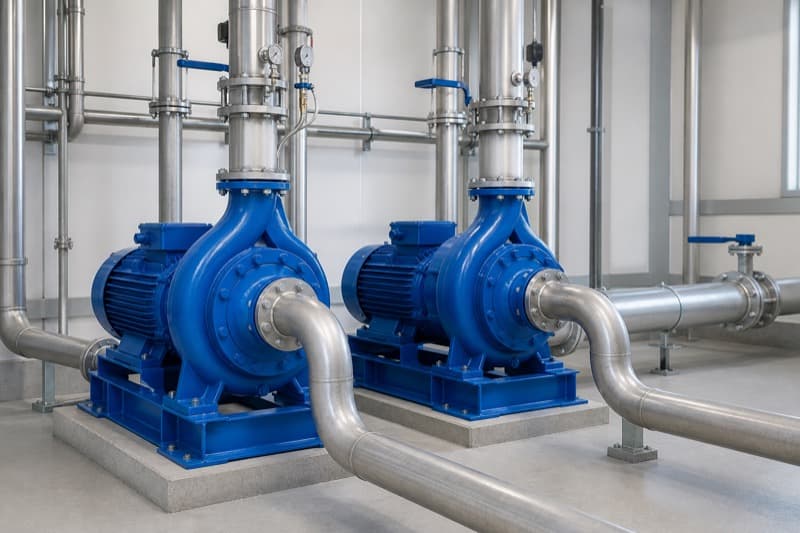
NLS sources both horizontal ring-section multistage pumps, which lay the stages out along a horizontal shaft and suit skid-mounted RO and feedwater duty, and vertical inline multistage pumps, which stack stages vertically in a compact footprint that fits a plant room or riser closet better than a horizontal unit would. Reference standards are API 610 for the BB4 (axially split, multistage) and BB5 (radially split, multistage) pump types used in petroleum and process service, and ISO 9906 for the hydraulic performance test grades that verify a pump meets its stated curve.
NLS quotes multistage pumps against the duty point (flow, head, and for RO service the feed water salinity and recovery rate) and returns a priced quote in USD. Stage count and metallurgy, often duplex or super-duplex stainless steel for high-salinity RO feed, drive both price and lead time, so NLS confirms material spec early rather than pricing off a generic stainless assumption that a factory later rejects.
Specifications
- ✓Configuration: horizontal ring-section and vertical inline multistage
- ✓Pressure range: up to 80 bar depending on stage count and application
- ✓Standards referenced: API 610 (BB4/BB5 types), ISO 9906 performance grades
- ✓Material options: cast iron, stainless steel, duplex and super-duplex stainless for high-salinity RO feed
- ✓Sizing basis: flow rate, total head, and for RO/desalination duty, feed salinity and recovery rate
- ✓Typical use: reverse osmosis and desalination feed, boiler feedwater, high-rise pressure boosting
Frequently Asked Questions
Why does reverse osmosis need a multistage pump instead of a standard centrifugal pump?+
RO membranes need feed pressure in the 15 to 80 bar range to push water across the membrane against osmotic pressure, well beyond what a single impeller stage can build at a workable flow rate. Stacking multiple impellers in series is how the pump reaches that pressure without an unsafe impeller speed.
What's the difference between horizontal and vertical multistage pumps?+
Horizontal multistage pumps lay their stages along a horizontal shaft and suit skid-mounted RO trains and boiler feedwater systems with room for a horizontal footprint. Vertical inline multistage pumps stack stages vertically, fitting a smaller floor area, which is why building services engineers favor them for plant rooms and riser closets on high-rise pressure boosting.
Does NLS need to know the water salinity to quote an RO feed pump?+
Yes. Feed salinity and target recovery rate set the pressure the pump has to deliver and often determine whether the wetted parts need to be duplex or super-duplex stainless instead of standard stainless, which changes both price and lead time.
Who supplies Multistage Pumps in Saudi Arabia?+
NLS Industries (Northlane Solutions Company) supplies Multistage Pumps across Saudi Arabia, including Riyadh, Jeddah, Dammam and Jubail. Send your specification and quantities to info@northlanesolution.com for a quotation.