
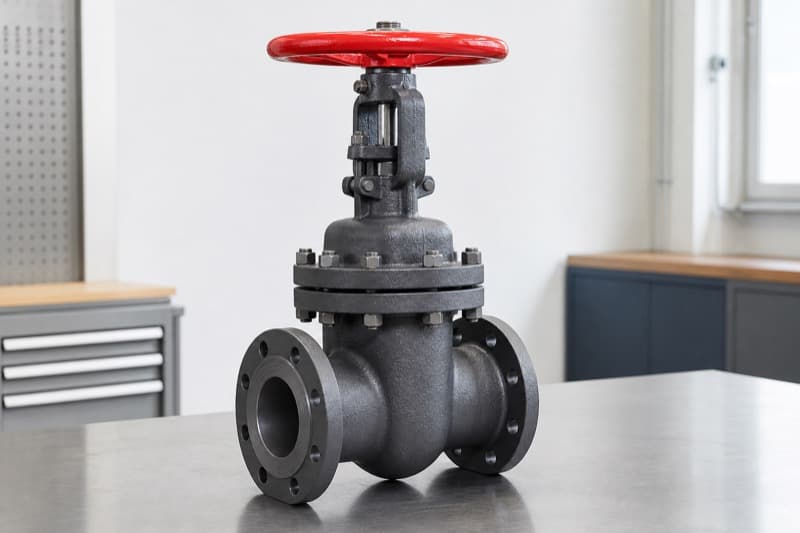
Gate Valves
Gate valves give full-bore, unrestricted flow when open and a tight shutoff when closed, used for isolation rather than throttling. NLS sources cast steel, cast iron, and stainless steel gate valves from 2 to 24 inches, rated 150# to 900#, to API 600, API 6D, and BS 1414, for pipeline isolation on process, utility, and firewater systems.
A gate valve isolates flow rather than controls it. In the open position, the gate lifts fully clear of the bore, so pressure drop across the valve is close to zero, which is exactly why gate valves aren't specified for throttling: running one partially open erodes the seat and gate face over time. Closed, a wedge or parallel-slide gate seats against the body to give bubble-tight or near bubble-tight shutoff depending on the seat material and class.
NLS sources gate valves in cast steel (WCB, LCC, WC6, WC9 for higher temperature and pressure service), cast iron for lower-pressure utility lines, and stainless steel (CF8, CF8M) where the line carries a corrosive or high-purity fluid. Size range runs 2 inches to 24 inches, pressure classes 150# through 900#, rising stem and non-rising stem configurations, flanged or butt-weld end connections. Reference standards are API 600 for cast steel gate valves, API 6D for pipeline valves, and BS 1414 or BS 5150 where a project spec calls for a British-standard valve instead.
On Saudi projects, gate valves show up as pipeline sectioning valves, tank farm isolation, firewater main isolation, and utility water and process line isolation wherever a full-bore, low-pressure-drop shutoff matters more than flow control. Firewater and utility applications typically specify cast iron or ductile iron at lower pressure classes; process and hydrocarbon lines call for cast or forged steel at higher classes with fire-safe design where the spec requires it.
Sourcing follows the same pattern as NLS's other categories: send the line size, pressure class, body material, and end connection, either from a valve schedule or a P&ID, and NLS returns a priced quote in USD. Common sizes and classes in cast steel typically source faster than large-bore or unusual pressure-class combinations, which may need a manufacturer lead time quote before NLS can confirm delivery.
Specifications
- ✓Body material: cast steel (WCB/WC6/WC9), cast iron, stainless steel (CF8/CF8M)
- ✓Size range: 2 inch to 24 inch
- ✓Pressure classes: 150# through 900#
- ✓Standards referenced: API 600, API 6D, BS 1414/5150
- ✓Stem type: rising stem (OS&Y) and non-rising stem
- ✓End connections: flanged (RF/RTJ) and butt-weld
Frequently Asked Questions
What's the difference between a gate valve and a globe valve?+
A gate valve is built for full-open or full-closed isolation with minimal pressure drop when open, not for throttling. A globe valve is built to throttle flow at any position between open and closed, at the cost of a higher permanent pressure drop even fully open.
Can a gate valve be used to throttle flow?+
It's not recommended. Running a gate valve partially open lets flow erode the seat and gate face, which shortens its service life and eventually causes leakage even when fully closed. A globe or control valve is the correct choice for throttling duty.
What size and pressure range does NLS supply for gate valves?+
NLS sources gate valves from 2 inches to 24 inches, in pressure classes 150# through 900#, in cast steel, cast iron, and stainless steel body materials, matched to the project's valve schedule.
What standards do Saudi projects usually specify for gate valves?+
API 600 for cast steel gate valves and API 6D for pipeline valves are the most common references on process and hydrocarbon work, with BS 1414 or BS 5150 specified on projects following British-standard practice.
Who supplies Gate Valves in Saudi Arabia?+
NLS Industries (Northlane Solutions Company) supplies Gate Valves across Saudi Arabia, including Riyadh, Jeddah, Dammam and Jubail. Send your specification and quantities to info@northlanesolution.com for a quotation.