
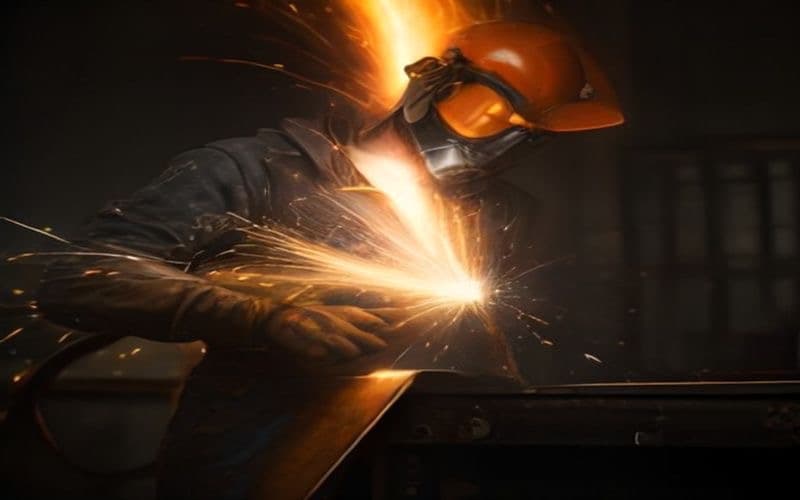
Gas Welding Equipment
Gas welding equipment, regulators, blowpipes, and hoses, controls and delivers oxygen and fuel gas (usually acetylene) for oxy-fuel welding, brazing, heating, and cutting, a process still used where power isn't available or a controllable flame suits the work better than an electric arc. NLS sources regulators to ISO 2503 and blowpipes/torches to ISO 5172, matched to gas type.
Gas welding, more precisely oxy-fuel welding when acetylene is the fuel gas, joins metal by melting it with a flame produced by burning fuel gas in oxygen, rather than with an electric arc. The equipment chain that makes this work is entirely mechanical: pressure regulators step the cylinder's high pressure down to a safe, controllable working pressure, hoses carry the gas from cylinder to torch, and the blowpipe (torch) mixes oxygen and fuel gas at the tip and lets the operator control flame size and character by adjusting both gas flows. No electricity is involved anywhere in the process, which is exactly why it's still specified on some site work.
NLS sources single-stage and two-stage regulators to ISO 2503, two-stage giving more stable downstream pressure as cylinder pressure drops through a job, along with blowpipes and torches to ISO 5172 sized for welding, brazing, or cutting attachments on the same handle. Flashback arrestors, a required safety component that stops a flame front from traveling back up the hose into the regulator or cylinder, get sourced alongside the regulator and torch as a complete, code-compliant set rather than quoted as an afterthought. Hose sets follow the standard color and connection convention; oxygen and fuel gas run in separate, differently threaded lines that can't be cross-connected by mistake.
On Saudi site and fabrication work, gas welding and its companion process, oxy-fuel cutting, still cover site repair and maintenance welding where power access is limited, pipe and structural steel preflame cutting and beveling ahead of arc welding, and brazing work on copper and dissimilar-metal joints that an electric arc process handles poorly. It's less common as a primary structural joining process today, arc welding covers that ground, but the equipment stays standard kit on most fabrication sites for cutting, heating, and brazing tasks.
NLS quotes gas welding equipment against gas type, regulator stage configuration, and whether the set needs welding, brazing, or cutting attachments, and returns a priced quote in USD. Standard single-gas regulator and torch sets typically source faster than complete multi-attachment kits with cutting and heating nozzles, which often carry a longer manufacturer lead time depending on the attachment range specified.
Specifications
- ✓Regulators: single-stage and two-stage configurations to ISO 2503, matched to gas type and cylinder pressure
- ✓Blowpipes/torches: ISO 5172, interchangeable welding, brazing, and cutting attachments on a common handle
- ✓Flashback arrestors: required safety component preventing flame return into hose, regulator, or cylinder
- ✓Gas types: oxygen and acetylene (or LPG) supported, non-interchangeable threaded connections by gas type
- ✓Applications: welding, brazing, flame cutting, and heating attachments available on the same equipment set
- ✓Hose sets: color-coded and separately threaded for oxygen and fuel gas lines
Frequently Asked Questions
What's a flashback arrestor and why is it required on gas welding equipment?+
A flashback arrestor stops a flame front that has traveled back into the hose, a flashback, from reaching the regulator or the gas cylinder, where it could cause an explosion. It's a required safety component on any oxy-fuel welding or cutting set, not an optional accessory.
Why would a project still specify gas welding instead of arc welding?+
Gas welding equipment needs no electrical power, which makes it useful for site repair where power access is limited. It also produces a softer, more controllable heat that suits brazing and thin-material or dissimilar-metal joints better than an electric arc process, and it doubles as the basis for oxy-fuel cutting and flame heating.
Does NLS supply complete oxy-acetylene welding and cutting sets?+
Yes. NLS sources regulators, blowpipes, hoses, and flashback arrestors as a complete set, along with welding, brazing, and cutting attachments, quoted against the gas type and the attachment range a project needs.
Who supplies Gas Welding Equipment in Saudi Arabia?+
NLS Industries (Northlane Solutions Company) supplies Gas Welding Equipment across Saudi Arabia, including Riyadh, Jeddah, Dammam and Jubail. Send your specification and quantities to info@nlsindustries.com or info@northlanesolution.com for a quotation.
Related products
Welding Accessories
Welding accessories, ground clamps, torch nozzles and contact tips, chipping hammers, welding blankets and curtains, are the supporting hardware that keeps a welding operation running and its surroundings protected, distinct from the machine and filler metal itself. NLS sources ground clamps, torch consumable parts matched to machine brand, and fire-rated welding blankets for Saudi fabrication and site work.
Welding Machines
Welding machines supply the controlled electrical current that MMA/stick, MIG/MAG, and TIG welding processes need to strike and hold an arc, sized by output amperage and duty cycle to match the joint thickness and process. NLS sources single and three-phase inverter welding machines from 140A to 500A, MMA, MIG/MAG, and TIG capable, for fabrication and site welding on Saudi structural steel and piping projects.
Welding Consumables
Welding consumables, electrodes, MIG/TIG wire, and flux, must match the base metal and welding process, not be chosen generically, since the wrong filler metal can pass a visual check and still fail a mechanical test. NLS sources MMA electrodes, MIG/MAG wire, and TIG filler rod to AWS A5 classifications, for carbon steel, stainless, and low-alloy welding on Saudi projects.
MIG/TIG Welding Machines
MIG/MAG and TIG welding machines are process-specific power sources. MIG/MAG synchronizes wire feed speed with output voltage for continuous-wire welding; TIG delivers a stable, controlled arc for tungsten electrode welding, often needing AC output for aluminum. NLS sources MIG/MAG machines with synergic wire-feed control and TIG machines with AC/DC output and pulse capability, to IEC 60974-1, for Saudi fabrication.
Welding Electrodes
Welding electrodes are the coated consumable rods used in MMA (stick) welding, where the coating burns to shield the arc, adds alloying elements, and forms a slag layer that controls how the weld cools. NLS sources carbon steel electrodes to AWS A5.1 and ISO 2560, across rutile, basic (low-hydrogen), and cellulosic coating types, matched to the joint's position.
Filler Wires
Filler wire is the consumable fed into a MIG/MAG or TIG weld, solid spooled wire for MIG/MAG and straight-length rod for TIG, and both have to match the base metal's chemistry, not just its general grade. NLS sources carbon steel MIG wire to AWS A5.18, low-alloy wire to AWS A5.28, and TIG filler rod to ISO 636.